|
On 27 June 2014 Ukraine's President Petro Poroshenko signed a free trade agreement with European leaders, cutting import tariffs with the European Union and committing the country to an ambitious programme of political and economic reform.
At the same time two other countries, Georgia and Moldova, signed similar agreements , officially called an "Association Agreement and Deep and Comprehensive Free Trade Area".
President Poroshenko described the agreement as a "symbol of faith and unbreakable will". He saw the signing as the start of preparations for joining the EU.
European Council President Herman Van Rompuy told leaders of the three countries "The EU stands by your side, today more than ever before." He added that there was nothing in the agreements that might harm Russia in any way. The Russian government has economic concerns about the agreements - it is worried that the Russian market could be flooded by cheaper goods from the EU that could undermine Russian producers. In September 2014, in the hope of easing tensions with Russia, the EU and Ukraine agreed to postpone implementing the trade agreement for a year. So until 2016 Ukraine will restrict imports from the EU, but have full access to the EU market for its own exports. In return, Russia has agreed to keep favourable trade rules in place for Ukraine as a former Soviet republic.
Background
As part of its broader Neighbourhood Policy, covering several Mediterranean and eastern European countries, the European Union had for some time been negotiating a trade agreement with the Ukrainian government. It was expected that the Agreement would serve as a motive for reforms, and in particular would open the doors for an international effort to help the country avoid bankruptcy.
The Ukrainian government of President Viktor Yanukovich announced on 21 November 2013 that it had decided to stop its preparations to sign the planned Association Agreement with the EU. Instead it would accept financial help from the Russian government.
Following the news that President Yanukovich had failed to sign the Association Agreement at the EU Vilnius summit on 28-29 November, hundreds of thousands of Ukrainians took to the streets of Kyiv in what is called the EuroMaidan protest, demanding his resignation.
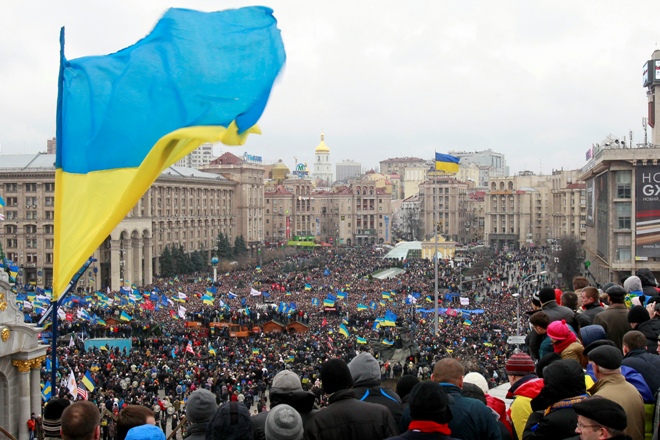
Riot police were ordered to clear the protest. In violence during February 2014 over 70 people died, many killed by snipers or machine-gun fire.
On 21 February Ukrainian opposition leaders signed an EU-mediated peace deal with President Yanukovich. But the protestors said they would remain in place until Yanukovich resigned. On 22 February Yanukovich fled Kyiv and the Speaker of the Verkhovna Rada (Parliament) Oleksander Turchinov took over as acting president.
Ukraine’s new government said it wanted to sign the Association Agreement with the EU at the 20-21 March summit of EU leaders, despite concern that hasty signing of the Association Agreement could further antagonise Russia.
In presidential elections held on 25 May 2014 Petro Poroshenko was elected in the first round with 54% of the vote.
Among the previous EU pre-conditions to signing the Association Agreement was the liberation of former prime minister Yulia Tymoshenko from jail, which happened on Saturday 22 February, as well as a commitment to reform the judiciary, which is one of the biggest priorities for the new government. Yulia Tymoshenko was thus able to stand in the May 2014 presidential elections but did not achieve a high vote.
It was on 21 March 2014 that Ukraine and the EU had signed the political half of an Accord forging closer ties with the EU. The same day Russian President Vladimir Putin signed a law endorsing Russia's takeover of Crimea from Ukraine, defying sanctions from the EU and the US.
Shortly after being elected President Poroshenko pledged to sign as soon as possible the economic part of the association agreement with the EU which had been signed in March. The agreement aimed to establish a free trade area and take steps toward visa-free travel, while committing Ukraine to economic and judicial reforms. Poroshenko has needed carefully to balance moving the country towards closer ties with Europe alongside trying to improve relations with neighbouring Russia.
Following a parliamentary election held on Sunday 26 October 2014, the pro-Western parties of President Poroshenko and Prime Minister Arseniy Yatseniuk won 44% of the overall vote and were expected to form a coalition government. There was a turnout of 52%, but voting did not take place in the eastern districts of Donetsk and Luhansk under the control of separatist rebels, nor in Crimea, which had been annexed by Russia earlier in the year in March.
|


