History

The Kingdom of Spain was created in 1492 with the unification of the Kingdom of Castile and the Kingdom of Aragon. In this year Christopher Columbus made his first voyage to the New World, beginning the development of the Spanish Empire.

For the next three centuries Spain was the most important colonial power in the world and the most powerful state in Europe. It established a vast empire in the Americas, stretching from California to Patagonia, and established colonies in the western Pacific.

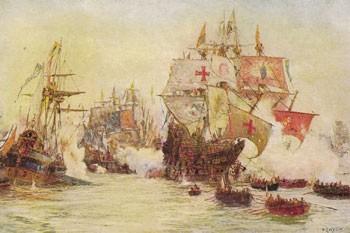
Engaging the Spanish Armada - William L Wyllie RA, naval artist In Europe, in the 16th and 17th centuries, Spain was heavily engaged in religious or territorial wars in today's Netherlands, Italy, France, England, Germany and Sweden. The economic damage of the wars led to the country's decline. It did however remain a major colonial power.

The 18th century saw the replacement of the Hapsburg dynasty by the Bourbons and a revival of state institutions. The end of the eighteenth and the start of the 19th centuries saw turmoil throughout Europe as a result of the French Revolutionary and Napoleonic wars, which led to the French occupation of much of the continent, including Spain. This triggered a successful but devastating war of independence that shattered the country and created an opening for what would ultimately be the successful independence of Spain's mainland American colonies.

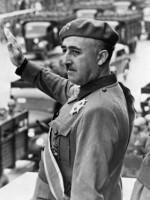
Following a period of growing political instability in the early 20th century, in 1936 Spain was plunged into a violent civil war which ended in a nationalist dictatorship under General Franco. He remained in power until 1975. Spain was officially neutral during World War II, although many Spanish volunteers fought on both sides.

The post-war decades were relatively stable and the country experienced rapid economic growth in the 1960s and early 1970s. The death of Franco in 1975 resulted in the return of the Bourbon monarchy.
Generalísimo Francisco Franco, fascist ruler of Spain 1939–1974

While tensions remain, for example with Basque separatists, modern Spain has seen the development of a robust, modern democracy as a constitutional monarchy under King Juan Carlos. Membership of the European Union in 1986 has helped consolidate the country's democratic institutions and its economic development.