|
During the first four AD centuries the people living in Norway were in contact with Roman-occupied Gaul. Contact with the civilised countries farther south brought a knowledge of runes; the oldest known Norwegian runic inscription dates from the 3rd century. Hunting, fishing and farming peoples were displaced by Germanic tribes after the fall of the Roman Empire, settled mainly in farming communities.
Expert boat-building opened the seas both to traders and raiders. In the 9th and 10th centuries seafarers left Norway to live in Iceland, the Faroes, Greenland, and parts of Britain and Ireland. The modern-day Irish cities of Dublin, Limerick and Waterford were founded by Norwegian settlers.
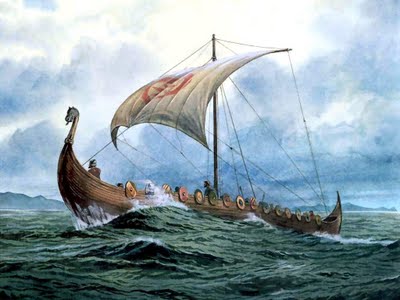
Two centuries of Viking raids into Europe eased following the adoption of Christianity at the end of the 10th century. Norwegian power peaked in 1265, but competition from the Hanseatic League and the spread of the Black Death weakened the country. By the end of the 14th century Norway had been absorbed into a union with Denmark that lasted more than four centuries.
It was the Swedish empire that next threatened Norway's independence. In 1814, Norwegians resisted their country being ceded to Sweden and adopted a new constitution, though they accepted union under a Swedish king. Rising nationalism throughout the 19th century led to the 1905 referendum which brought independence to Norway. Although Norway adopted neutrality in the two World Wars, it was occupied for five years by Nazi Germany (1940-45). In 1949, neutrality was dropped and Norway became a member of NATO.
Discovery of oil and gas in Norwegian waters in the late 1960s substantially changed Norway's economy. It has since become one of the richest populations in Europe. In referenda held in 1972 and 1994, the majority rejected joining the EU.
|


